VERKLINE WAS-616-75 Toyota GR Yaris engine and gearbox mounts red - product gallery
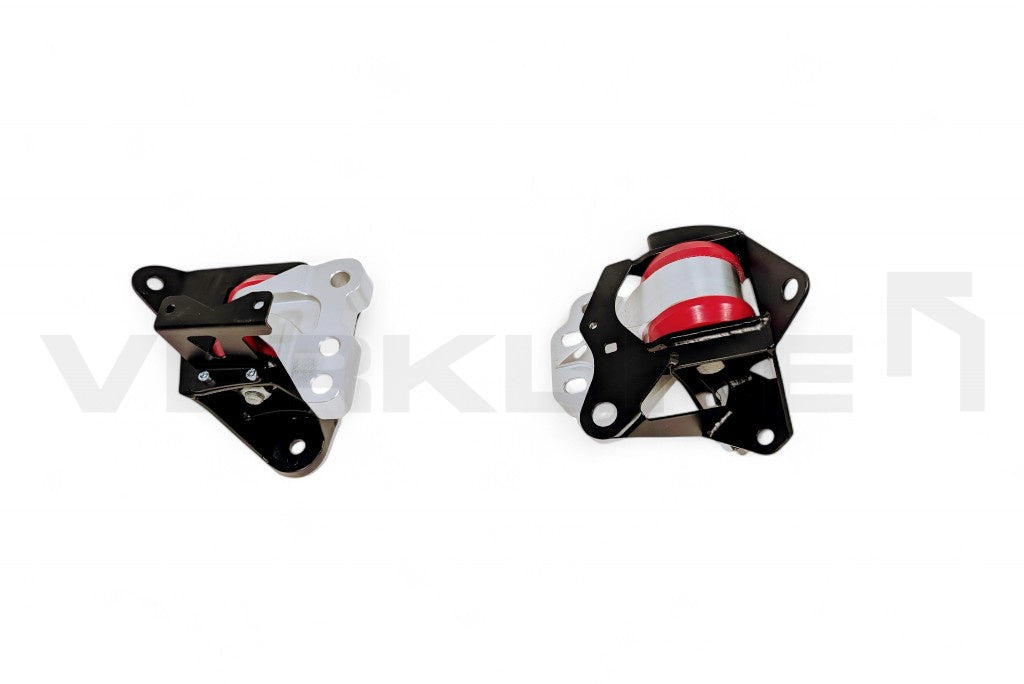
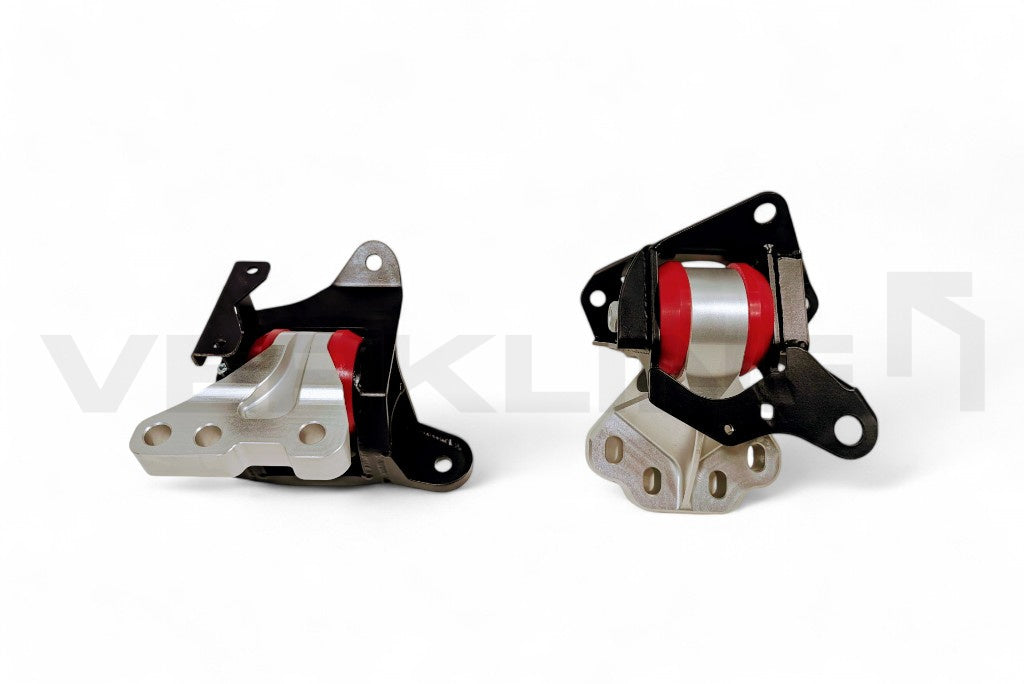
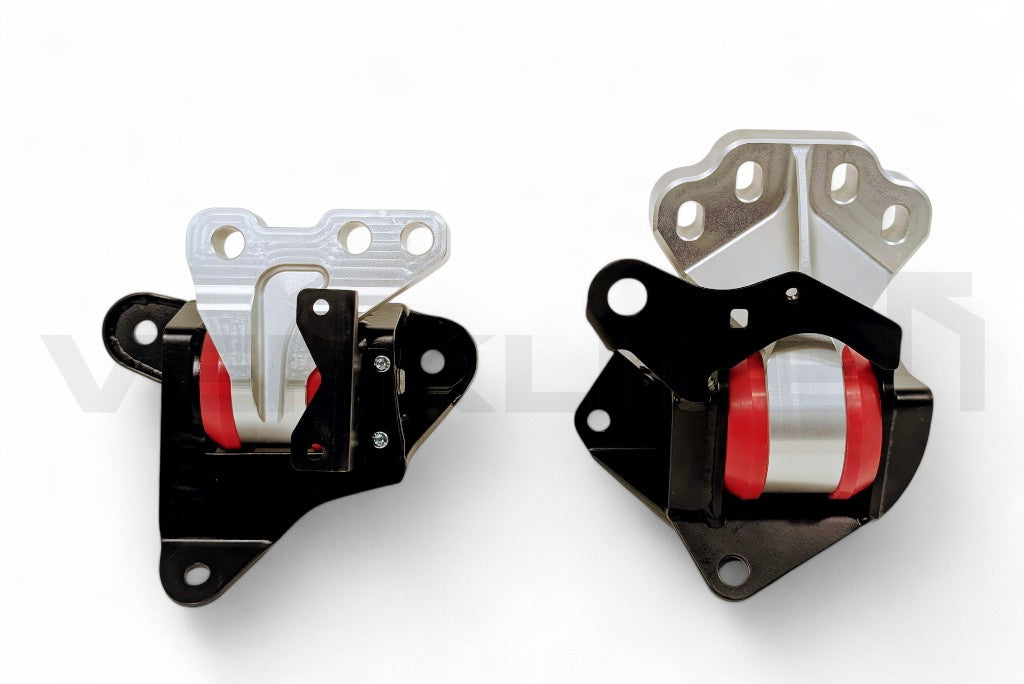
Toyota GR Yaris engine and gearbox mounts red
Engine & Gearbox Mount Set - Toyota GR Yaris (GXPA16)
WAS-616-75
CNC-machined billet engine and gearbox mounts with polyurethane bushings for the Toyota GR Yaris G16E-GTS powertrain. Designed from scratch - not an OEM insert, not a modified stock part. A complete replacement engineered to hold your engine exactly where it belongs under forces exceeding 5.7 kN.
THE GR YARIS PROBLEM - WHAT TOYOTA DIDN'T OPTIMIZE FROM THE FACTORY
POWER TRANSFER
Delayed by every gear change
When you shift and apply throttle, the G16E-GTS first has to twist against soft OEM rubber mounts before torque reaches the wheels. The engine rocks, the rubber compresses, and only after the mounts deform to equilibrium does full power transfer begin. With 3.08 kNm of torque reaction during hard acceleration - that delay is measurable.
ENGINE DISPLACEMENT
200 kg on soft rubber
The G16E-GTS engine and gearbox assembly weighs approximately 200 kg, supported by just three mount points. Under 1.5g engine braking, each side mount absorbs up to 5.74 kN of force. OEM rubber bushings deform significantly under these loads - the engine physically moves in the bay, changing half-shaft CV joint angles and exhaust alignment.
DRIVETRAIN GEOMETRY
CV angles change under load
Every time the engine moves on its mounts, the front half-shaft CV joints operate at angles they were not designed for. The GR Yaris AWD system sends torque through both front and rear driveshafts - and with 5.74 kNm reaction moments trying to rotate the engine forward under hard braking, OEM rubber allows enough movement to affect drivetrain efficiency and accelerate CV joint wear.
MATERIAL DEGRADATION
Rubber hardens, cracks, fails
OEM rubber engine mounts are designed for NVH comfort, not performance. They absorb vibration - but they also absorb your throttle response. Under heat cycling from the engine bay and repeated high-load deformation on track, rubber hardens and cracks. The result is progressive wheel-hop under hard acceleration, inconsistent gear shifts, and a throttle response that gets worse over time with no visible warning until the mount fails completely.
The WAS-616-75 replaces the entire OEM mount assembly with a CNC billet structure and polyurethane bushings - engineered from FEA load data, not modified from a comfort part.
Why WAS-616-75
Most competitors sell polyurethane inserts that fit inside the original rubber mount housing. You keep the OEM stamped steel bracket - with all its compromises. The WAS-616-75 replaces the entire assembly: CNC-machined billet aluminium brackets (anodized), precision-turned aluminium sleeve, and the largest possible polyurethane bushings the packaging allows. Steel components are black powder-coated for corrosion resistance. All hardware is grade 10.9 galvanized. Every component is new, purpose-designed, and manufactured to tolerances that stamped OEM parts cannot achieve.
Every mount is validated through Finite Element Analysis against six real-world load scenarios calculated from vehicle dynamics data: engine braking at 1.5g (5.74 kN per mount), acceleration at 2g (3.08 kN), cornering at 2g (2 kN lateral), front half-shaft torque reaction, rear propshaft torque reaction through the 41/18 differential ratio, and combined inertial loads. These are not theoretical estimates - they are derived from the GR Yaris weight transfer spreadsheet and 3D chassis scans.
Solid mounts give zero compliance - maximum power transfer, but also maximum vibration transmitted to the chassis. OEM rubber gives comfort but absorbs your throttle inputs. Polyurethane sits exactly where a performance car needs to be: significantly stiffer than rubber for faster power transfer and reduced engine movement, but with enough controlled compliance to keep the car liveable on the road. Even Toyota Rally2 cars use rubber mounts at approximately 85 Shore A hardness - not solid.
The WAS-616-75 uses all original OEM mounting points on both the engine/gearbox and the chassis side. No drilling, no welding, no cutting. The RH mount (WAS-615) includes a dedicated CNC bracket for the coolant reserve tank - a detail competitors overlook, forcing you to find alternative mounting solutions. Install one mount at a time, torque to OEM specifications (42-72 Nm depending on location), and the job is done. Full reversibility to stock.
Running 350+ HP or a sequential gearbox? The standard red polyurethane is not enough.
Above 350 HP the torque reactions through the mounts exceed what standard polyurethane can control without excessive deflection. The Black Race version SKU: WAS-616-85 uses a harder durometer compound specifically rated for high-power and sequential gearbox applications. This is not optional for these builds - it is required to maintain the engine position under the increased loads. When ordering, add information that you need the Black version in the order comments to receive the Black Race version.
What Is Included
The WAS-616-75 ships as a complete left + right engine mount set - 14 precision-manufactured components ready to install. No reuse of OEM brackets, no modification of stock parts.
WHAT YOU GET: VERKLINE vs. INSERT-STYLE COMPETITORS

WAS-614 - LH (Gearbox Side)
• 1x Gearbox mount bracket (CNC billet)
• 1x Chassis mounting bracket (CNC billet)
• 1x Precision-turned aluminium sleeve
• 2x Polyurethane bushings
• 1x Bolt M14x1.5x100 (DIN 6921)
• 1x Nut M14x1.5 (ISO 12126, 127 Nm)

WAS-615 - RH (Engine Side)
• 1x Engine mount bracket (CNC billet)
• 1x Chassis mounting bracket (CNC billet)
• 1x Precision-turned aluminium sleeve
• 2x Polyurethane bushings
• 1x Reserve tank mounting bracket (CNC)
• 1x Bolt M5x8 (ISO 4762, 4 Nm)
• 1x Bolt M14x1.5x100 (DIN 6921)
• 1x Nut M14x1.5 (ISO 12126, 127 Nm)
RECOMMENDATION: The GR Yaris powertrain uses three mount points - two side mounts (WAS-616-75) and one lower torque mount. For complete engine bay rigidity, we recommend adding the WAS-610 Lower Torque Mount [ View WAS-610 ] to eliminate all remaining rubber compliance in the powertrain mounting system.

Vehicle Compatibility
• Toyota GR Yaris (GXPA16): 2020+
• Standard and Circuit Pack versions
• G16E-GTS 1.6L turbo 3-cylinder
• OEM manual gearbox
• Sequential gearboxes (X-Shift tested)
• Compatible with stock and tuned engines
• Replaces OEM mounts on both sides
Engineering Approach
The WAS-616-75 development started with a complete 3D scan of the GR Yaris engine bay, gearbox, and chassis mounting points. The geometry presented a challenge - the LH gearbox mount has a 3-degree angular offset that had to be accounted for in the bracket design to ensure proper load paths without introducing bending moments during installation.
Load cases were built from first principles using actual GR Yaris vehicle dynamics data. Engine and gearbox mass of approximately 200 kg was distributed across three mount points. Torque reactions from the front half-shafts and rear propshaft were calculated through the GR-FOUR AWD system, accounting for the rear differential ratio (41/18) and tire contact patch forces under braking (1.5g) and acceleration (2g). Lateral inertia under 2g cornering was applied to verify the mounts resist all six degrees of freedom.
The critical design decision was treating the mount points as force-only connections - not moment-carrying joints. With three widely-spaced points in the engine bay, moments are resolved into force couples across the mount pairs rather than applied as bending moments to individual brackets. This simplifies the load path and makes the FEA results more conservative and reliable. The resulting structure was validated against all six load scenarios before machining began.
Technical FAQ
Will I feel more vibration inside the car?
Yes - slightly, and intentionally.
Polyurethane transmits more engine vibration than OEM rubber - that is the trade-off for faster throttle response and reduced engine movement. The G16E-GTS is a 3-cylinder engine, which has inherently more unbalanced vibration than a 4-cylinder. At idle you will notice a slight increase in vibration through the steering wheel and pedals - this is more pronounced than on 4-cylinder applications. At speed it becomes unnoticeable because road and wind noise dominate. Most owners describe it as "the car feels more connected" rather than uncomfortable. This is not a solid mount - the WAS-616-75 uses the largest possible polyurethane bushings the packaging allows, specifically to maximize damping while maintaining performance. If your priority is absolute NVH comfort, keep the OEM mounts. If your priority is driving precision, the WAS-616-75 is designed for you.
Why not solid mounts for maximum performance?
Because even factory rally cars don't use solid mounts.
The G16E-GTS is a 3-cylinder engine - and 3-cylinder engines produce significantly more vibration than 4-cylinder units due to inherent primary force imbalance. Bolting this engine to the chassis through solid mounts would transmit all of that vibration directly into the body structure. The result is accelerated fatigue on chassis mounting points, stress risers around bolt holes, and real risk of cracking the firewall or bulkhead on cars that see sustained track or rally use. Even the Toyota GR Yaris Rally2 uses rubber bushings rated at approximately 85 Shore A - not solid. Polyurethane gives you the overwhelming majority of the rigidity benefit while absorbing enough of the 3-cylinder vibration to protect both the chassis and the driver. It is the solution that engineering teams choose when the car needs to last, not just be fast for one session.
Why is this better than a polyurethane insert in the OEM mount?
An insert only changes the bushing. The bracket is still the OEM stamped part.
Polyurethane insert products (such as those from Powerflex or Hardrace) replace only the rubber element inside the original equipment bracket. The OEM stamped steel housing - designed for comfort-oriented rubber compliance - remains. You get stiffer bushings working inside a structure that was never designed for the increased load transfer. The WAS-616-75 replaces everything: CNC billet brackets on both the engine side and chassis side, precision-machined sleeve, and polyurethane bushings. The entire load path is new, calculated, and validated as a system - not a stiffer element forced into a softer structure.
How does the WAS-616-75 affect throttle response?
Faster power transfer - especially noticeable during gear changes.
With OEM rubber mounts, every time you change gear and reapply throttle, the engine first has to twist against the soft mounts. The rubber compresses, the engine rotates on its axis, and only after the mounts reach a new equilibrium does the full torque reaction path through the half-shafts become efficient. With stiffer polyurethane, this "wind-up" phase is dramatically shorter. The result is a more immediate connection between your right foot and the contact patches. Drivers consistently describe it as the single most noticeable improvement per euro spent on a GR Yaris.
Do I need the WAS-610 lower torque mount as well?
Recommended but not required.
The GR Yaris G16E-GTS powertrain sits on three mount points: two side mounts (the WAS-616-75 set) and one lower torque mount. The WAS-616-75 addresses the primary load-bearing mounts that resist engine weight, braking forces, and cornering loads. The lower torque mount (WAS-610) primarily resists longitudinal rocking under acceleration and deceleration. Installing the WAS-616-75 alone will give you the majority of the improvement. Adding the WAS-610 completes the system and eliminates the last remaining rubber compliance in the powertrain mounting.
What about the coolant reserve tank on the RH side?
Included. A dedicated CNC bracket is part of the WAS-615 set.
The OEM coolant reserve tank is mounted to the factory engine mount bracket on the RH side. When you replace the stock bracket, you lose the tank mounting point. Many competitors ignore this - leaving you to improvise a solution. The WAS-615 (RH mount) ships with a dedicated CNC-machined reserve tank bracket (WAS-615-A1-10-B) that bolts directly to the new engine mount with an M5x8 fastener. The tank sits in its original position with no modification needed.
What is the Black Race version?
A stiffer polyurethane option for high-power and sequential gearbox applications.
For engines exceeding 350 HP or cars running sequential gearboxes (such as X-Shift), the standard polyurethane may not provide enough rigidity. The Black Race version uses a harder durometer polyurethane compound that reduces engine movement further under the increased torque loads. The trade-off is more NVH transmitted to the cabin - this version is recommended for dedicated track or rally cars where comfort is not a priority. Contact us to order the Black Race variant.
Is the WAS-616-75 compatible with sequential gearboxes?
Yes - tested with both OEM and X-Shift sequential gearboxes.
The mounting geometry is validated for both the factory manual gearbox and aftermarket sequential units including X-Shift. Sequential gearboxes transmit higher shock loads during shifts, which is why we strongly recommend the Black Race polyurethane variant for these installations. The bolt pattern and clearances accommodate both gearbox types without modification.
Can I install this myself?
Professional installation recommended. Always install one mount at a time.
The installation requires properly supporting the engine with a height-adjustable lift attachment before removing any mount. Never remove both mounts simultaneously. A torque wrench is mandatory - OEM bolt specifications range from 42 Nm to 72 Nm depending on location, and the main M14x1.5 polyurethane through-bolt torques to 127 Nm. All provided nuts are single-use distorted thread locknuts. After installation, recheck all fasteners after the first 100 km. Detailed fitting instructions with tightening sequences are included.
CNC Precision
Milled from solid aluminum or steel
2 Years Warranty
Full manufacturer warranty
Shipping within 24 hours
From our warehouse if item is in stock
Made in Poland
Designed and manufactured in Poland (Europe)