VERKLINE WAS-330 Porsche 991 GT3 GT3RS GT2 suspension upgrade kit - product gallery
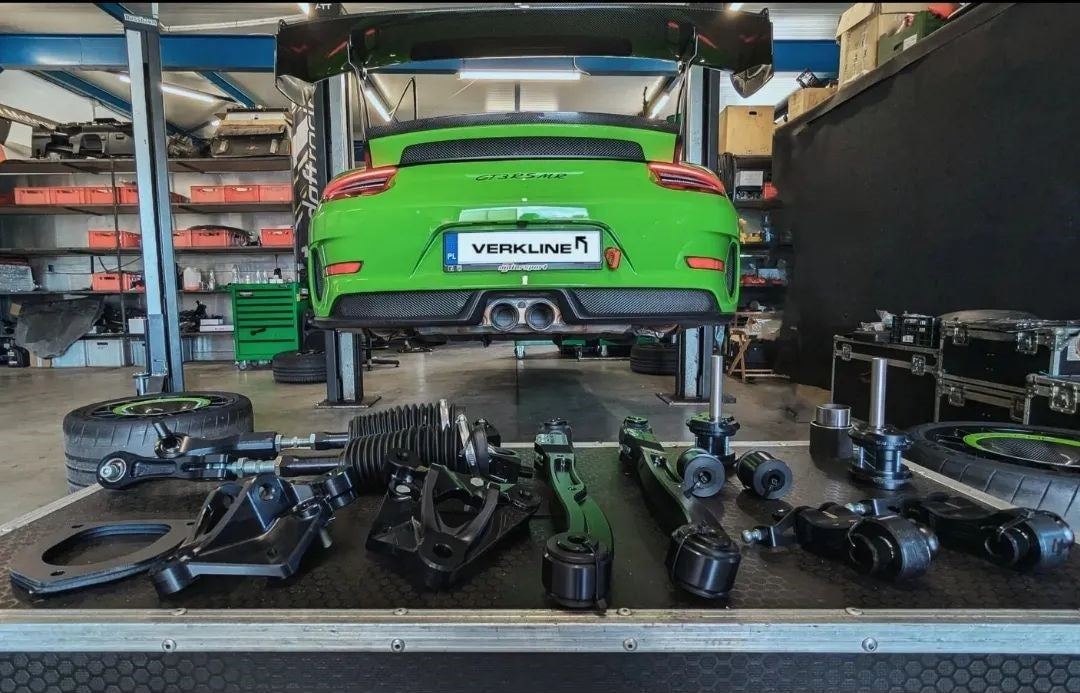
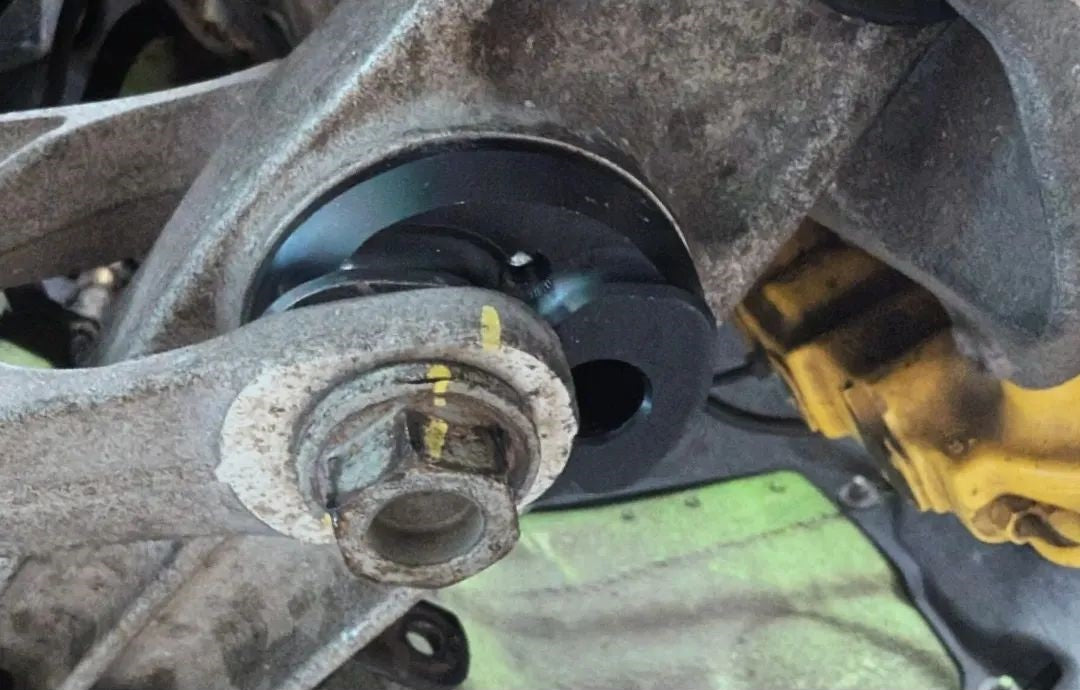
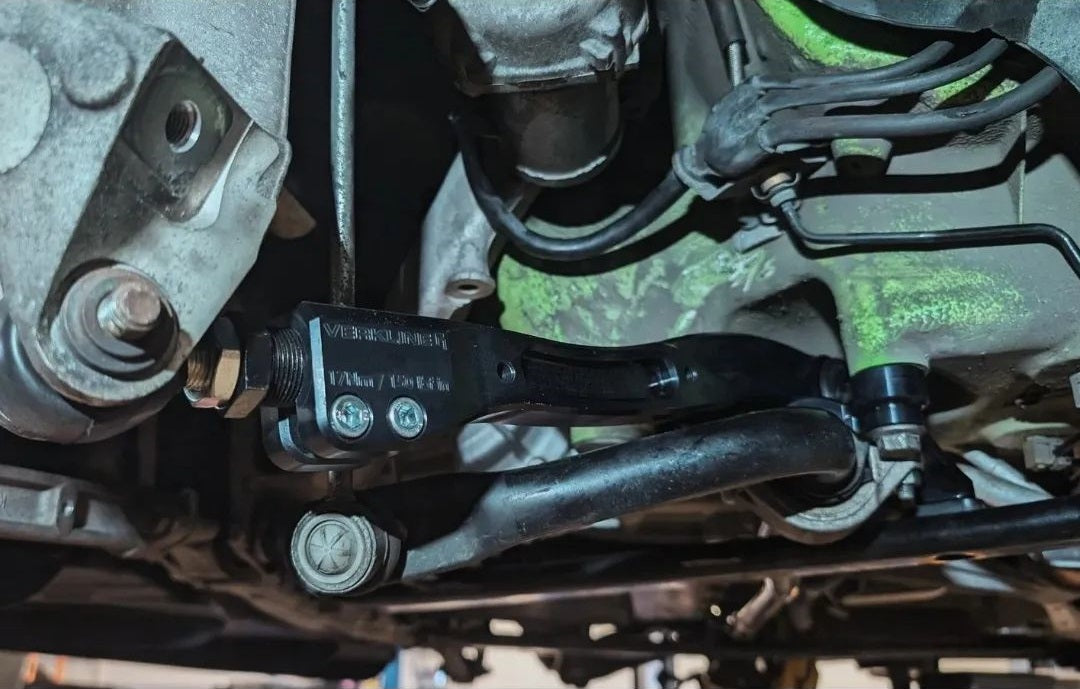
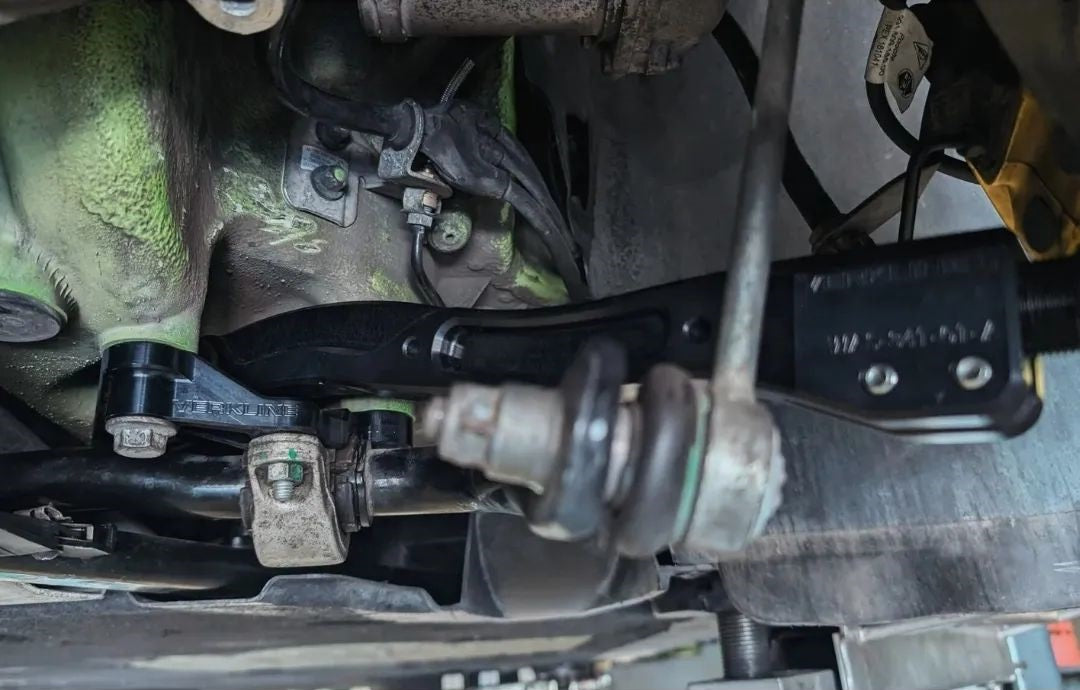
Porsche 991 GT3 GT3RS GT2 suspension upgrade kit
VERKLINE Suspension Upgrade Kit — WAS-330
Porsche 911 GT3 / GT3 RS / GT2 RS (991.1 & 991.2) — Front track widened by 20 or 30 mm · Front camber up to −4.5° · Independent caster adjustment · Linearised rear bump steer · Developed from a full 3D scan of the 991 chassis
Why the WAS-330 is a system, not a parts list
Many competitors offer individual arms for the 991 — a front camber arm here, a toe link insert there. Each part addresses one symptom in isolation. The WAS-330 was engineered differently: every component was developed simultaneously on a full 3D scan of the actual 991 chassis, so that the geometry corrections, adjustment ranges and bearing axes work together as a coordinated system. The front tie rod corrects the bump steer introduced by the wider inner arm. The WAS-333 bushing decouples caster from camber for the first time. The WAS-341 and WAS-345 together eliminate every remaining rubber pivot from the rear kinematic chain. None of these components is optional — each one is the logical consequence of the others.
The 991 Problem — What Porsche didn't fully solve from the factory
The 911 GT3, GT3 RS and GT2 RS are extraordinary machines — developed with genuine motorsport intent and track-capable suspension from the factory. But even these cars carry geometry compromises that become real handling problems the moment you run them at track camber values or push them hard on demanding circuits like the Nordschleife.
The WAS-330 kit addresses all four problems — WAS-333 decouples caster from camber; WAS-331 widens the front track by 20 or 30 mm and unlocks camber up to −4.5° toward GT3 Cup spec; WAS-341 fixes the rear bump steer geometry at the root. All developed from a full 3D scan of the actual chassis.
Product Highlights
The rubber pivots in the front inner control arm and front thrust arm are replaced with EU-manufactured Getecno PTFE-lined motorsport spherical bearings — the same standard used in Pagani road cars. These are the specific points where OEM compliance creates a gap between your static alignment and what the tyre contact patch sees on track under load.
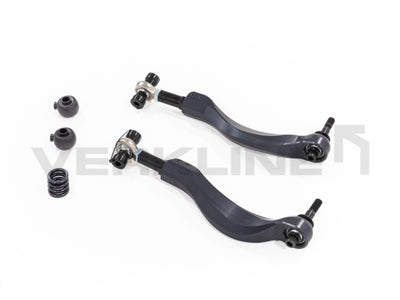
The WAS-333 thrust arm bushing decouples caster from camber adjustment. Set camber for grip and caster for steering feel — without the wheel moving forward toward the arch. Two offset positions (10 mm standard, 15 mm aggressive) allow precise baseline setting without rotating the bushing on every adjustment.
The WAS-331 front inner control arm increases front track width by 20 mm or 30 mm total — moving the road car geometry toward GT3 Cup specification. A wider track reduces lateral load transfer under cornering, increasing total front axle grip. The wider arm also unlocks the camber adjustment range: the kit supports front camber from the stock −1.5° all the way to −4.5°, accommodating everything from fast road use to full semi-slick track setups.
On the OEM 991, each camber value produces a different rear bump steer curve — so a single generic correction fixes one camber setting and leaves every other one wrong. The WAS-341 trailing arm relocates the chassis mounting point so the curve is linearised, parallel at all camber values, and independently adjustable. Change your camber, and the bump steer characteristic stays the same.
The WAS-341 trailing arm eliminates the geometric problem. The WAS-345 rear toe link insert completes it: it replaces the last remaining rubber bushing in the rear kinematic chain with a spherical bearing. Together, these two components give the rear axle fully rigid pivot points across every load direction — and expand the rear toe adjustment range beyond OEM limits, which becomes essential when running a widened front track and aggressive camber values.
What is included — WAS-330
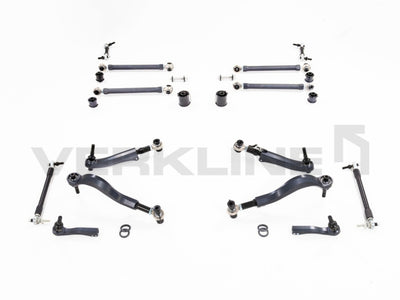
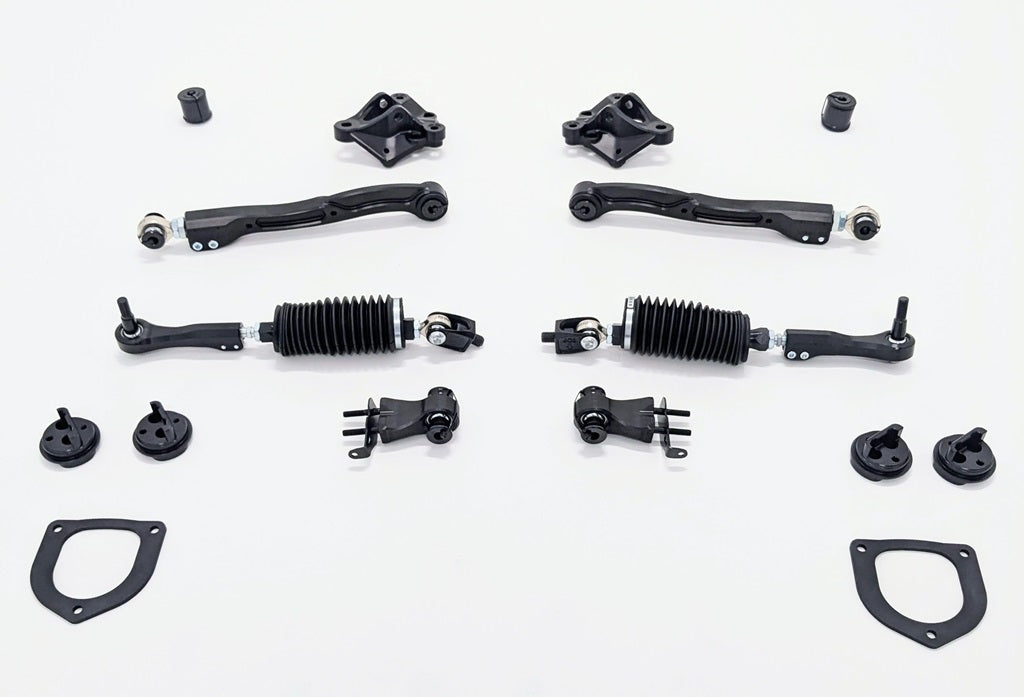
The WAS-330 is a complete front-and-rear system. Every component was developed together on a full 3D scan of the 991 chassis — functioning as a coordinated kinematic solution, not a collection of independently sourced parts.
Front Axle
•2x Front Inner Control Arms (WAS-331 — wider track, spherical bearing inner pivot)
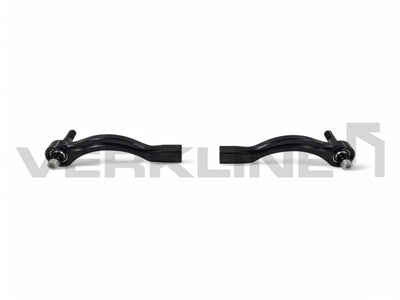
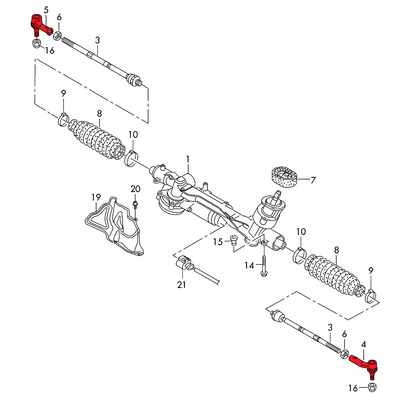
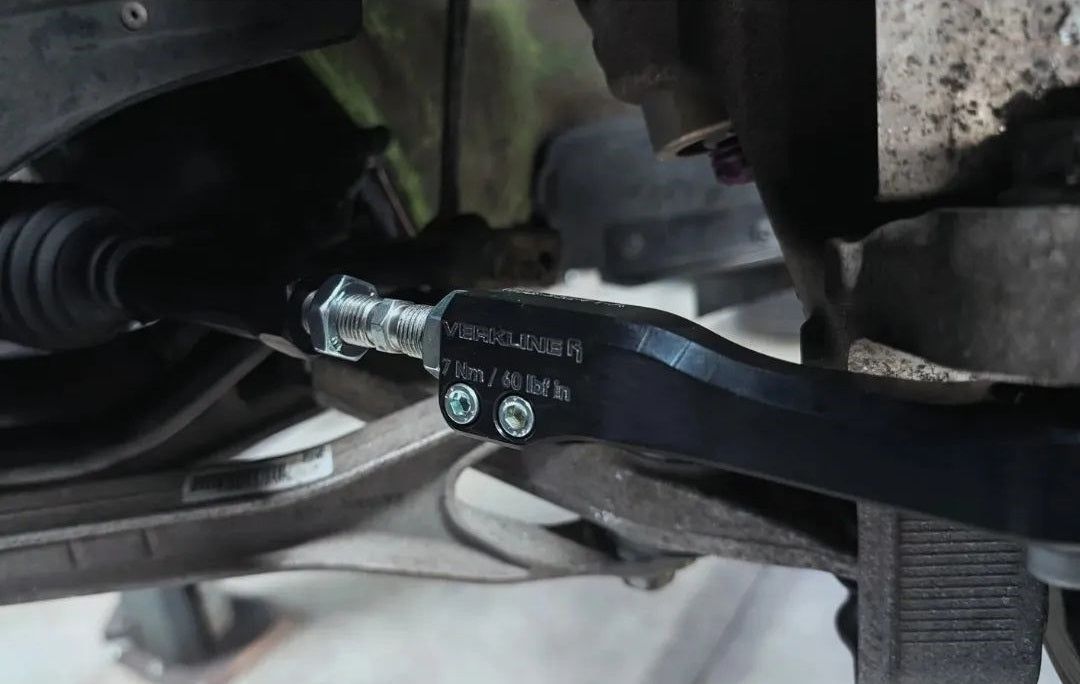
•2x Front Tie Rods (WAS-332 — bump steer corrected for wider track geometry)
•2x Front Thrust Arm Bushings (WAS-333 — independent caster, 10 mm / 15 mm offset positions)
•2x Front Top Mount Spacers (WAS-334 — arch clearance compensation for wider track)
Rear Axle
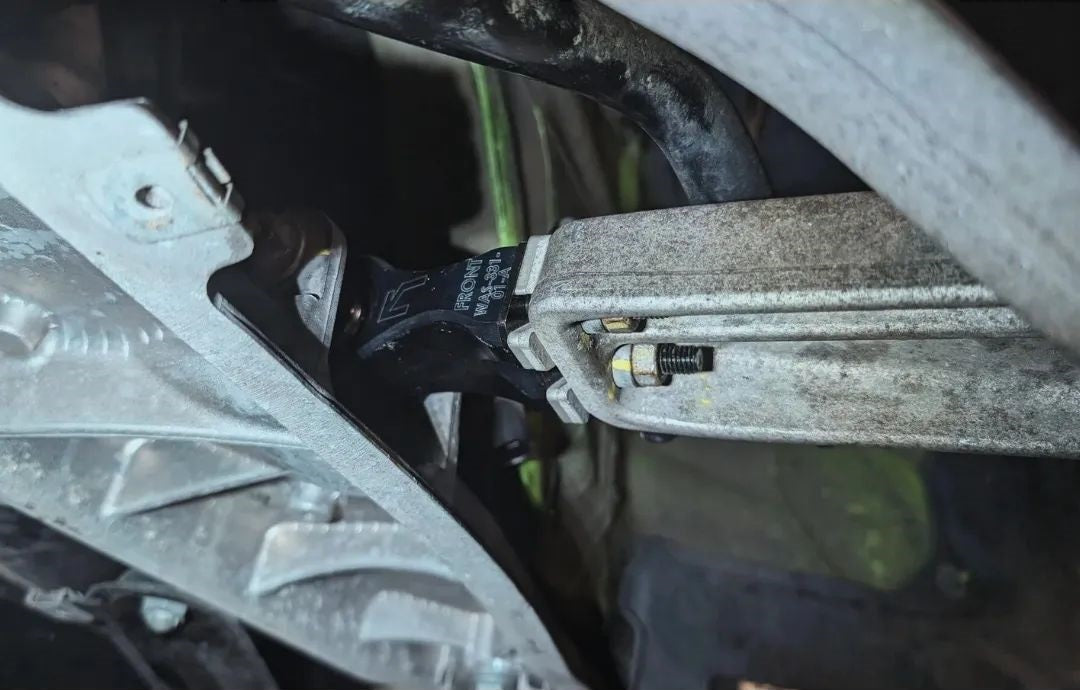
•2x Rear Trailing Arms with Brackets (WAS-341 — linearised, camber-independent bump steer geometry)
•2x Rear Toe Link Inserts (WAS-345 — the last remaining rubber pivot in the rear kinematic chain, replaced with a spherical bearing; also expands rear toe adjustment range)
•23-page assembly & setup manual (incl. Nürburgring GP Track and Nordschleife presets)
Why the rear bump steer problem can't be fixed with a generic toe link
In the 991's 5-link rear suspension, bump steer and static camber are geometrically linked through the trailing arm mounting point. The problem is not just that bump steer grows at higher camber — it is that each camber setting produces a completely different curve.
Graph 1 — OEM: why a single correction doesn't fix the problem

Each line shows rear toe angle change as the suspension travels through ±50 mm of heave at a different static camber setting. The curves fan out — each camber value produces a different slope and shape. Any correction set at −1.5° camber becomes wrong at −2.5°. Any correction set at −2.5° is excessive at −1.5°. There is no single generic adjustment that handles all of them. This is a geometric limitation of the OEM trailing arm mounting point — not a tuning problem.
Graph 2 — WAS-341: three things corrected simultaneously

The WAS-341 trailing arm relocates the chassis mounting point to fix the geometry at the root. The result is three simultaneous improvements: the curves are now straight lines (linearised); they are parallel at every camber setting (camber-independent); and you choose which line you want (independently adjustable). Change your camber and the bump steer characteristic stays the same.
The specific setup values and the arm length table for different camber and bump steer combinations are covered in the 23-page manual supplied with every kit.
Vehicle Compatibility
•Porsche 911 GT3 (991.1): 2013 – 2016
•Porsche 911 GT3 (991.2): 2017 – 2019
•Porsche 911 GT3 RS (991.1): 2015 – 2016
•Porsche 911 GT3 RS (991.2): 2018 – 2019
•Porsche 911 GT2 RS (991.2): 2017 – 2019
System Design Philosophy
Most kits are a collection of parts. VERKLINE is a system.
Every component of the WAS-330 was developed on a full 3D scan of the 991 chassis — so bearing axes, adjustment ranges and clearances work together by design, not by assumption.
This gives you two guarantees no mixed-parts setup can offer:
•Zero Interference: No collisions between parts across any suspension setup.
•Optimised Bearing Articulation: Every spherical bearing operates within its ideal range at any alignment setting.
See exactly what this means in practice — compare both scenarios below.
Engineering Philosophy: Built for the 991's Specific Geometry
The WAS-330 is not a generic suspension upgrade. It is a chassis-specific kinematic solution, developed from a full 3D scan of the 991 GT3 platform.
The 991 GT3 is already a highly developed car. The improvements this kit delivers are not gross corrections of a compromised platform — they are precise solutions to specific, documented limitations found in the actual kinematic data: the camber-caster coupling that creates arch clearance risk; the front track width reduction that comes with OEM camber shims; and the rear 5-link geometry that produces a different bump steer curve at every camber value, making a single generic correction structurally insufficient.
Every component addresses one of these specific problems. The WAS-332 front tie rods correct the bump steer introduced by the wider-track inner arm. The WAS-333 bushing decouples caster from camber for the first time on the 991 — solving a problem Porsche Motorsport itself documents in technical guidance for Nordschleife use. The WAS-341 trailing arm relocates the chassis mounting point to make the rear curve linear and parallel at all camber values — independently adjustable. The WAS-334 top mount spacer is a calculated consequence of the wider track geometry, not an afterthought. The WAS-345 toe link insert closes the rear kinematic chain by replacing the last remaining rubber pivot.
Included Setup Documents
Every WAS-330 kit ships with a 23-page chassis-specific setup document developed for the 991 GT3 / GT3 RS / GT2 RS. This is not a generic alignment guide — it covers arm positions, shim stack configurations, the WAS-341 trailing arm length table, and recommended alignment targets for each use case, including dedicated presets for the Nürburgring GP Track and Nordschleife.
Technical FAQ
Q: Why does adjusting camber on the OEM 991 also change caster — and why is this a problem?
Q: What does wider front track width actually do for circuit performance?
Q: Why does the kit include a top mount spacer — is it just a clearance fix?
Q: Why replace the front inner control arm rather than the full front camber arm?
Q: Why does the WAS-330 include an expanded rear toe adjustment range — and when does this matter?
Q: What alignment is required after installation?
Q: What bearings are used and why does it matter?
CNC Precision
Milled from solid aluminum or steel
2 Years Warranty
Full manufacturer warranty
Shipping within 24 hours
From our warehouse if item is in stock
Made in Poland
Designed and manufactured in Poland (Europe)